

“The Anti-Corruption Strategy for 2026–2030 is the result of two years of joint work by hundreds of experts who, step by step, have shaped a clear vision of what Ukraine’s anti-corruption policy should be over the next five years. The idea of creating a programmatic document, the implementation of which will subsequently make it possible to reduce the level of corruption in Ukraine to levels fully comparable with those of EU countries, has united us with representatives of dozens of other state institutions, leading academic and analytical centres, international partners, and the public. I am deeply convinced that only a systemic and coordinated anti-corruption policy, based on high-quality data and developed with broad involvement of both state and non-state stakeholders, is capable of ensuring Ukraine’s steady anti-corruption progress in the future,” said Dmytro Kalmykov, Deputy Head of the National Agency on Corruption Prevention (NACP).
The adoption of the Anti-Corruption Strategy for 2026–2030 will not only enable the proper fulfilment of one of Ukraine’s key international legal obligations. But it will also ensure the implementation of a comprehensive, balanced, gradual, and proactive anti-corruption policy, the result of which will be a stable and significant reduction in the level of corruption in Ukraine.
This article describes in detail the process of preparing the draft Anti-Corruption Strategy for 2026–2030, from the initial idea through completion and submission for consideration and approval.
Principles for Preparing the Strategy
The development of the draft Anti-Corruption Strategy for 2026–2030 constitutes an international legal obligation of Ukraine and is mandated, at a minimum, by the following documents:
- Recommendations of the European Commission provided in the Ukraine Progress Reports under the European Union Enlargement Package for 2024 and 2025;
- The Rule of Law Roadmap.
- the European Union initiative “Ukraine Facility”;
- The Joint Statement by Commissioner for Enlargement M. Kos and Deputy Prime Minister for European and Euro-Atlantic Integration of Ukraine T. Kachka, made on 11 December 2025 in Lviv;
- The Rule of Law Action Plan was identified by Ukraine and the EU as a priority for implementation in 2026.
At various stages of this lengthy preparation process, reliable international partners were involved, including representatives of:
- the European Commission;
- The Organisation for Economic Co-operation and Development;
- the “Digitalisation for Growth, Integrity and Transparency” Project (UK DIGIT) / Eurasia Foundation / UK Dev;
- The European Union Anti-Corruption Initiative in Ukraine (EUACI)
- The Basel Institute on Governance;
- the OSCE Support Programme for Ukraine;
- The United Nations Development Programme in Ukraine.
A Two-Year Journey of Meticulous Work by an “Army” of Ukraine’s Leading Experts
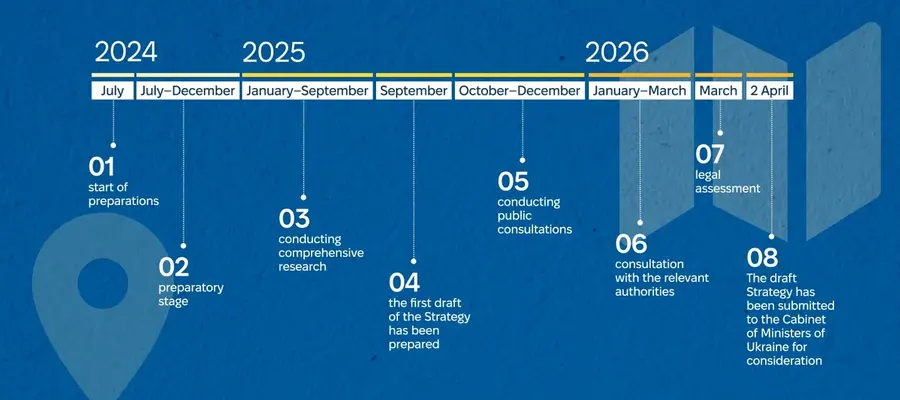
The NACP carried out the preparation of the draft Anti-Corruption Strategy for 2026–2030 continuously for nearly two years, starting from mid-2024.
Preparatory Stage (July – December 2024)
- A general conceptual approach was developed, as well as the Roadmap for the development of the draft Anti-Corruption Strategy for 2026–2030, which was submitted to the European Commission.
- An “inventory” of all state functions was conducted, and a List of Public Policy Areas of Ukraine was compiled.
- A methodology for determining the Corruption Risk Index across areas of public life was developed and implemented.
- 16 sectors most affected by corruption were identified for further in-depth research and incorporation of the findings into Section II of the Anti-Corruption Strategy for 2026–2030;
- Methodological Guidelines were developed for conducting research and drafting provisions of the Anti-Corruption Strategy for 2026–2030, based on the most advanced global practices in public policy development.
Conducting Comprehensive Research and Drafting the First Version of the Document (January – September 2025)
- 26 expert teams were established to prepare:
a) 10 studies dedicated to a thorough analysis of challenges and the identification of solutions across all key institutions within the general system of corruption prevention and counteraction (see the structure of Section I below);
b) 16 studies dedicated to a thorough analysis of challenges and the identification of solutions in the 16 sectors most affected by corruption (see the structure of Section II below);
- Representatives of 25 academic institutions, leading analytical centres, and civil society organisations were engaged in the work of these teams;
- The total number of experts involved in preparing the draft Anti-Corruption Strategy for 2026–2030 amounted to 138 experts.
- Based on 26 comprehensive studies conducted by leading experts in the respective fields, the first draft of the Anti-Corruption Strategy for 2026–2030 was prepared (September 2025).
Broad Public Engagement (October – December 2025)
During October–December 2025, the National Agency organised and conducted 26 public consultations (a separate consultation was held for each subsection):
- total duration of discussions – over 55 hours;
- total number of participants – more than 790 persons;
- 267 comments, as well as 411 remarks and proposals – a total of 678 inputs.
Each comment, remark, and proposal submitted by representatives of civil society was subject to careful consideration and in-depth analysis by the specialists of the National Agency.
As a result of reviewing 411 specific remarks and proposals to the draft:
- accepted – 257 (62%);
- partially accepted – 60 (15%);
- not accepted – only 94 (23%).
On the website of the National Agency, you can read about the general schedule of these public consultations on the draft Anti-Corruption Strategy for 2026–2030.
For each public consultation (separately for each subsection), you can access:
- the text of the relevant subsection draft submitted for public consultation;
- analytical materials underpinning the respective component of the Anti-Corruption Strategy for 2026–2030;
- the agenda of the public consultation;
- the presentation for the respective subsection draft;
- the video recording of the public consultation;
- The report on the results of processing comments, proposals, and remarks expressed during the public consultation.
- The revised text of the respective subsection will follow the public consultation.
Following each of the 26 public consultations, a separate report was prepared and published, reflecting the results of a thorough review of every remark, proposal, and even individual comment.
Coordination with Stakeholders (January – March 2026)
On 7 January 2026, the National Agency submitted the draft Anti-Corruption Strategy for 2026–2030:
- for coordination to 15 ministries, i.e. to all central executive authorities responsible for shaping state policy in each respective area;
- for expert review regarding compliance with Ukraine’s obligations in the field of European integration, including international legal obligations and European Union law;
- for positions and feedback to all-Ukrainian associations of local self-government bodies, the Joint Representative Body of representative all-Ukrainian trade union associations at the national level, the Joint Representative Body of the employers’ side at the national level, the Scientific Committee of the National Council for the Development of Science and Technology, and the National Tripartite Social and Economic Council.
The version of the draft Anti-Corruption Strategy for 2026–2030 submitted for coordination is available at the link.
After receiving all recommendations, proposals, and comments from stakeholders in February 2026, the National Agency proceeded to its substantive review.
Letters of approval (including those with comments and proposals) and opinions from stakeholders are available at the link.
In total, 339 comments, proposals, and recommendations were received on the draft Anti-Corruption Strategy for 2026–2030, including:
- 222 from relevant public authorities;
- 75 from stakeholders;
- 42 from the European Commission.
Following the consolidation, systematisation, and thorough review of all the above comments and proposals, the National Agency:
- organised 18 reconciliation meetings, with a total duration of approximately 50 hours;
- engaged more than 120 representatives of the entities that submitted proposals;
- Comprehensively revised the draft Anti-Corruption Strategy for 2026–2030 by taking into account (fully or partially) 85% of all submitted comments (including 91% of comments from relevant public authorities and 100% of recommendations from the European Commission).
Legal Review of the Draft Anti-Corruption Strategy for 2026–2030 (March 2026)
Subsequently, the National Agency submitted the revised draft Anti-Corruption Strategy for 2026–2030, updated following the reconciliation procedures, to the Ministry of Justice of Ukraine for legal review.
The vast majority of comments and proposals received as a result of the legal review were analysed and taken into account, and the draft Anti-Corruption Strategy for 2026–2030 was further refined.
On 2 April 2026, the draft Anti-Corruption Strategy for 2026–2030 was submitted to the Cabinet of Ministers of Ukraine for consideration.
The version of the draft Anti-Corruption Strategy for 2026–2030 submitted by the National Agency to the Government is available at the following links:
Objective, Tasks, and Structure of the Anti-Corruption Strategy for 2026–2030
The objective of the Anti-Corruption Strategy for 2026–2030 is to significantly reduce the level of corruption in Ukraine, to establish and advance the principles of democracy, the rule of law, and good governance, to ensure economic and social development, and to facilitate Ukraine’s accession to full membership in the European Union and the North Atlantic Treaty Organisation.
To achieve this objective, the Anti-Corruption Strategy for 2026–2030 applies a conceptual approach that consists of simultaneously ensuring the implementation of two strategically important tasks:
- ensuring the high effectiveness and continuous development of the overall system of corruption prevention and counteraction;
- minimising corruption in the most corruption-prone and strategically important sectors, primarily through the implementation of systemic sectoral reforms aligned with European Union legislation and incorporating best international practices.
Section I “General System of Corruption Prevention and Counteraction” includes 10 subsections dedicated to improving the following institutions of the general anti-corruption system:
- ensuring policy development, coordination of implementation, monitoring, and evaluation of the effectiveness of state anti-corruption policy;
- anti-corruption education, awareness-raising, and information policy;
- anti-corruption programs, authorised units (authorised persons) for the prevention and detection of corruption, integrity in the private sector;
- strategic analysis of corruption risks in priority sectors, anti-corruption assessment of draft and existing legal acts;
- conflicts of interest, related rules, prohibitions and restrictions, lobbying;
- financial control of declarants;
- protection of whistleblowers;
- legality and transparency of political finance;
- prevention and counteraction of corruption and corruption-related offences;
- independence, institutional resilience, and effectiveness of anti-corruption institutions.
Section II “Prevention of Corruption in Priority Sectors” includes 16 subsections aimed at implementing comprehensive reforms to minimise corruption in the following priority sectors:
- judiciary and the status of judges;
- prosecution, law enforcement, and counteraction to criminal offences;
- the legal profession and legal aid;
- defense;
- construction and infrastructure;
- recovery and reconstruction;
- energy;
- public procurement;
- state regulation and oversight in the economy;
- taxation;
- customs;
- subsoil use;
- land relations;
- agriculture;
- healthcare;
- education and science.
Section III “Mechanism for Implementation, Monitoring, and Evaluation of the Effectiveness of the Anti-Corruption Strategy” is aimed at ensuring the proper execution and implementation of the provisions of the draft Anti-Corruption Strategy for 2026–2030.
Sections I and II of the draft Anti-Corruption Strategy for 2026–2030 define the key problems and the expected strategic outcomes to be achieved during its implementation period, serving as indicators of addressing these problems.
Overall, the draft Anti-Corruption Strategy for 2026–2030 incorporates the need to address 146 problems identified through 26 comprehensive studies by achieving 444 expected strategic outcomes:
- Section I – 45 problems and 155 expected strategic outcomes;
- Section II – 101 problems and 289 expected strategic outcomes.
Partners Without Whom the Development of the Draft Anti-Corruption Strategy for 2026–2030 Would Not Have Been Possible
The preparation of the draft Anti-Corruption Strategy for 2026–2030 became possible thanks to a broad range of partners who brought together their expert potential, resources, and a shared vision of building an integrity-driven and transparent state.
The draft Anti-Corruption Strategy for 2026–2030 is a joint achievement of public authorities, international partners, and leading analytical centres, combining diverse experience and approaches to enhance the effectiveness of corruption prevention and counteraction.
Given the extensive journey we have undertaken together, the National Agency expresses its sincere gratitude to all those who contributed directly to the development of this strategic document.
In this context, we would first like to thank our reliable international partners, namely representatives of the European Commission, the Organisation for Economic Co-operation and Development (OECD), the “Digitalisation for Growth, Integrity and Transparency” Project (UK DIGIT) implemented by the Eurasia Foundation with the support of UK Dev, the European Union Anti-Corruption Initiative in Ukraine (EUACI), the Basel Institute on Governance, the OSCE Support Programme for Ukraine, and the United Nations Development Programme (UNDP) in Ukraine. Special words of appreciation are extended to the European Commission, which not only provided financial support for one of the comprehensive analytical studies but also became a key partner in the substantive refinement and provision of feedback on the entire draft Anti-Corruption Strategy for 2026–2030.
This strategic document must become the product of joint work and cooperation between the National Agency and several ministries and other public authorities. Therefore, we would like to express our sincere gratitude to our colleagues from the Ministry for Development of Communities and Territories of Ukraine, the Ministry of Defence of Ukraine, the Ministry of Health of Ukraine, the Ministry of Culture of Ukraine, the Ministry of Internal Affairs of Ukraine, the Ministry of Education and Science of Ukraine, the Ministry of Justice of Ukraine, the Ministry of Finance of Ukraine, the Ministry of Economy of Ukraine, the Ministry of Digital Transformation of Ukraine, the Ministry for Veterans Affairs of Ukraine, the Ministry of Foreign Affairs of Ukraine, the Ministry of Youth and Sports of Ukraine, the Ministry of Social Policy, Family and Unity of Ukraine, the Ministry of Energy of Ukraine, the High Anti-Corruption Court, the Specialized Anti-Corruption Prosecutor’s Office, the National Anti-Corruption Bureau of Ukraine, the Ukrainian Association of District and Regional Councils, the National Tripartite Social and Economic Council, the Association of Amalgamated Territorial Communities, and the Scientific Committee of the National Council of Ukraine for the Development of Science and Technology for their participation in the development and refinement of the draft Anti-Corruption Strategy for 2026–2030.
Special words of deep appreciation are extended to all researchers, experts, analysts, and representatives of civil society who became co-authors of the 26 comprehensive analytical studies and contributed directly to the development and refinement of the draft Anti-Corruption Strategy for 2026–2030:
- experts from leading Ukrainian think tanks, in particular Transparency International Ukraine, the Better Regulation Delivery Office (BRDO), the Reform Office of the Cabinet of Ministers of Ukraine, the Centre of Policy and Legal Reform (CPLR), the Anti-Corruption Action Center (AntAC), the Centre for Economic Strategy, the NGO “Technologies of Progress” (including the BRP project), the NGO “Institutional Development Foundation,” the NGO “Future Lawyer,” the NGO “Risk Assessment Center,” the NGO “Together Against Corruption,” the NGO “Centre for Society Research” (CEDOS), Agency for Legislative Initiatives, the Westminster Foundation for Democracy, the NGO “Independent Anti-Corruption Commission” (NAKO), the Energy Club of Ukraine (Energy Club), the think tank “We Build Ukraine,” the NGO “League of the Strong,” as well as the NGO “Holka”;
- representatives of academic and educational institutions, including experts from the National University of Kyiv-Mohyla Academy, V. N. Karazin Kharkiv National University, Lviv State University of Internal Affairs, King Danylo University, Kyiv National University of Technologies and Design, the National University of Life and Environmental Sciences of Ukraine, and the “Future of Ukraine” Programme of the Centre for Geopolitics at the University of Cambridge;
- numerous representatives of the business community, including the Ukrainian Agribusiness Club (UCAB), Altelaw&Sempra Law Firm, Arzinger Law Firm, iC consulenten, the design and construction company B PRO CONSULT, the audit firm “Aksyonova and Partners,” the Bar Association “Delta International Law,” the Velta Group of Companies, the Law Office “Vitaliy Tkachuk and Partners,” and others.
The National Agency also expresses its sincere gratitude to all those who participated in the series of public consultations on the draft Anti-Corruption Strategy for 2026–2030 and actively contributed to discussions by providing professional comments, remarks, and proposals. In particular, we extend our appreciation to representatives of the Council of Europe Office in Ukraine, Transparency International Ukraine, the Better Regulation Delivery Office (BRDO), the Centre of Policy and Legal Reform (CPLR), the Anti-Corruption Action Center (AntAC), the All-Ukrainian Network of Integrity and Compliance (UNIC), the Centre for Integrity in the Defence Sector at the Norwegian Ministry of Defence (CIDS), the NGO “Together Against Corruption,” the Anti-Corruption Research and Education Centre (ACREC), the Civil Network “OPORA,” the NGO “CHESNO Movement,” the International Institute for Democracy and Electoral Assistance (IDEA), the National Democratic Institute (NDI), the International Foundation for Electoral Systems (IFES Ukraine), the NGO “DEJURE Foundation,” the Anti-Corruption Center “Mezha,” Agency for Legislative Initiatives, the Ukrainian National Bar Association, the NGO “StateWatch,” the NGO “Principle,” the NGO “Public Control Platform,” Interstate Consultants Engineers Guild (ICEG), the NGO “Constitutional and Legal Congress,” the charitable organization “Bucha Alive,” the NGO “EU-LEAP,” the NGO “Institute of Analytics and Advocacy,” the Association of Customs Brokers of Ukraine, the NGO “Youth Development Center of Ukraine,” DiXi Group, the NGO “Association of Certified Geodesists of Ukraine,” the charitable organization “100% Life,” the charitable foundation “Wings of Hope Lviv,” the NGO “Association of Private Medical Institutions,” and the charitable foundation “Patients of Ukraine.”
Thus, the National Agency once again expresses its profound gratitude to everyone who contributed to this large-scale and socially significant process.
At the same time, we recognise that many challenges still lie ahead. Therefore, we count on continued consolidated support and further productive cooperation.
What’s Next?
From 6 to 10 April, the draft Anti-Corruption Strategy for 2026–2030 is under consideration by the Government Committee on European and Euro-Atlantic Integration, International Cooperation, Law Enforcement, Legal Policy, and Water Management Development.
It is expected that as early as next week, the document may be submitted for consideration by the Cabinet of Ministers of Ukraine.
We sincerely believe and hope that the Government Committee and the Cabinet of Ministers of Ukraine will be able to review and approve this strategic document in the near future, preserving all key initiatives both in the context of further strengthening the overall system of corruption prevention and counteraction and in terms of preventing corruption in priority sectors.

