

The National Agency on Corruption Prevention (NACP) has completed implementation of the nationwide Communication Strategy in the Field of Preventing and Counteracting Corruption for the period through 2025. The document, developed and adopted as part of the State Anti-Corruption Program for 2023–2025 (SAP), outlines the implementation of large-scale communication campaigns and educational projects on anti-corruption in Ukraine.
The Strategy facilitated the unification of communication specialists across various government agencies, primarily highlighting preventive anti-corruption measures across policy areas, including digitalisation and accountability, the provision of administrative services, and economic deregulation.
The content and adaptation of the Strategy’s educational activities were based on measurable data from sociological and expert surveys, regular monitoring of media and social networks, and analysis of disinformation narratives surrounding corruption and anti-corruption efforts.
Despite corruption being perceived by society as the primary national challenge after the war, between 18.6% and 69.9% of the population cannot clearly identify corrupt practices or distinguish them from other types of legal violations. To clarify the characteristics of corruption, its main forms, manifestations, offences, and corresponding liability, the NACP conducted an awareness campaign on social media using the hashtag #Corruption_is.... All thematic materials, including practical case studies, are available via this hashtag.
Over 90% of Ukrainians—9 out of 10—consider corruption very or somewhat widespread in the country. While citizens rate the effectiveness of anti-corruption bodies as below average, fewer than 10% of the population are aware of these institutions' activities and powers. To build a comprehensive understanding of the anti-corruption struggle over the long term, the NACP initiated the production of the first documentary on this topic in independent Ukraine: "After the Era of Silence." Produced by hromadske, the film explores the development and key features of anti-corruption infrastructure, explaining how anti-corruption bodies work together, their competencies, and results—including the prosecution of high-level corruption cases and the long-term impact of dismantling corrupt schemes.
To highlight the influence of anti-corruption reforms on the country's socio-political and economic processes, the video "Large-scale Corruption in Ukraine: How to Destroy the Evil?" was created by the educational project Price of the State. Additionally, the video "The Great Myth of Terrible Corruption" by the YouTube project Notevskyi was dedicated to debunking myths that shape the perception of corruption. Given the growth of the Ukrainian YouTube segment, the NACP continues to work on joint projects with prominent YouTube channels.
One of the Strategy's primary goals was to develop a comprehensive understanding of Ukraine's anti-corruption infrastructure. Beyond specialised institutions—NACP, NABU, SAPO, and HACC—this infrastructure encompasses a wide network of non-governmental organisations, activists, independent media, whistleblowers from various fields, and all proactive citizens who report corruption to the competent authorities.
The NACP conducted a separate communication campaign for whistleblowers, emphasising their status, legal protections, and reporting mechanisms for violations in specific areas of activity. Indeed, only one in six Ukrainians has adequate awareness of the legal guarantees for whistleblower protection, and only a quarter of the population is aware of the mechanisms for processing reports.
As part of the campaign, more than 50 releases and posts were published across NACP resources, along with analytical articles in the media, radio broadcasts, and segments on national television. A video instructional on using the Whistleblower Portal was created and distributed by more than 100 state bodies, and a unique comic-book guide was presented and distributed to more than 300 government authorities and about 20 media outlets. An interactive test was published on the national Diia.Education platform, allowing users to verify their level of knowledge about the specifics of the whistleblowing institution in Ukraine. Furthermore, the NACP co-organised two annual conferences on the topic of whistleblowing and partnered in a separate information campaign of the State Border Guard Service and a series of educational events by the National Police. The National Agency also prepared a series of explanatory posts on the requirements for corruption reports, a screencast on the most important ways to submit reports, and informational materials on the jurisdiction of anti-corruption bodies.
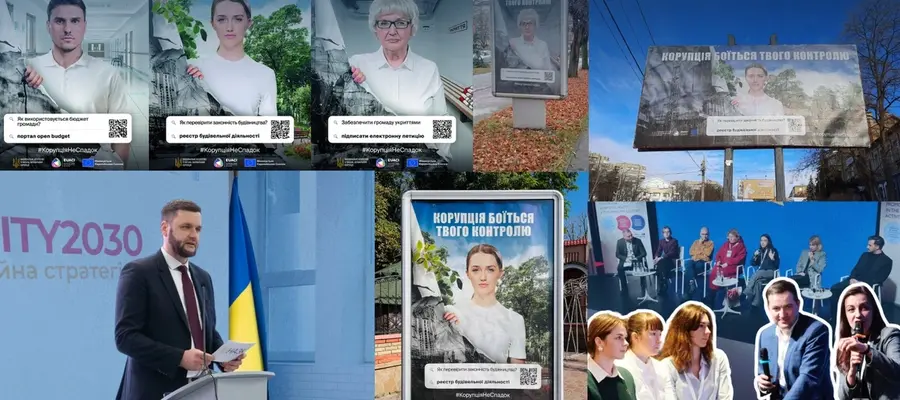
In recent years, a number of tools have been developed in Ukraine to enable citizens to participate in decision-making at the local and national levels, monitor government actions, and thus reduce opportunities for corruption. According to 20% of respondents, citizens share responsibility for combating corruption, while another 12% believe non-governmental organisations are responsible. To promote the effective use of public control tools — from electronic petitions to the Prozorro system — the NACP conducted a large-scale information campaign under the slogan “Corruption Fears Your Control.” The campaign materials (video clips, over 300 billboards, 250 city lights, and over 20,000 thematic posters) were broadcast on national and local TV channels and placed in public transport, at stations, in Administrative Service Centres, other administrative buildings, and on the streets of the country's cities and towns.
Although the percentage of the population with a negative attitude toward corruption reached a historic high in 2024 (57.9%), 14.6% of the population still justifies corrupt practices always or in most cases, and 30% tolerate them under certain conditions. At the same time, every fifth Ukrainian encounters corruption firsthand during the year. To promote integrity-based behaviour and practical action in corrupt situations, the NACP distributed 14 animated explanatory videos featuring the Pryntsypovych family, whose members demonstrate appropriate behaviour in modelled cases of corruption. Simultaneously, the National Agency participated in the preparation and distribution of a manual on the practical use of anti-corruption legislation, “Preventing Corruption is Simple.”
Another area of communication is the promotion of state services and initiatives that are alternatives to common corrupt practices. To this end, the NACP organised over 20 broadcasts with representatives of various state bodies on Ukrainian Radio. The main focus of the interviews was primarily digital state services, as the significant anti-corruption effect of digitalisation is still limited by an insufficient level of awareness and user experience among citizens regarding available digital opportunities and tools (about one-third of the population is sufficiently aware of such services). Among the key areas highlighted by experts during the broadcasts were social protection and healthcare, education, defence, construction, transport, customs, and environmental control.
In addition to the aforementioned campaigns, other topics were covered during the implementation of the Strategy using various communication formats: a video course on anti-corruption communications for communities, explanatory materials for the public and business regarding the new rules of administrative procedure, original analytical articles on whistleblowing, the link between anti-corruption and European integration, factors of anti-corruption progress in various countries, and more.
One of the Strategy's primary goals was to develop a communication infrastructure centred on anti-corruption. Over the course of two years, the NACP united the efforts of more than 100 specialists from communication units and anti-corruption authorised officers of key state bodies. During this period, seven coordination forums were held with the participation of public servants, representatives of leading Ukrainian media, non-governmental organisations, experts, and sociologists. These forums served as a platform for regular dialogue, the exchange of best practices, the implementation of non-standard communication formats, the development of information and educational materials, and the execution of campaigns.
To facilitate the exchange of information on initiatives and services that counter corrupt practices, the NACP established an Interagency Working Group. This group included, among others, representatives from the Ministry of Digital Transformation, the Ministry of Justice, the Ministry of Economy, the Ministry of Internal Affairs, the Ministry of Environmental Protection and Natural Resources, and the State Service of Ukraine on Food Safety and Consumer Protection. Additionally, the National Agency processed quarterly reports from each executive body of the Strategy regarding anti-corruption communication measures undertaken.
Public events within the framework of the Strategy became an important format for open partnership communications. These primarily included national anti-corruption forums timed to International Anti-Corruption Day, presentations of annual sociological and expert surveys on the state and perception of corruption in Ukraine, the results of public monitoring of the implementation of SAP measures, a public discussion on the digitalization of construction and reconstruction, the presentation of a study on disinformation narratives about corruption, and open meetings with the media.
The Strategy's initiatives were presented at international events: at the 33rd annual meeting of law enforcement and anti-corruption communicators of the European Union in July 2024 (the OLAF Anti-Fraud Communicators' Network (OAFCN)) and at the 24th annual professional conference and General Assembly of EPAC/EACN in November 2025. Based on the voting results of EPAC/EACN participants, the NACP project received positive feedback and took second place in the competition program.
A comprehensive assessment of the Strategy's impact will be possible in the near future, following the publication of the results of the annual sociological survey on the state of corruption in Ukraine for 2025. This data will allow for the tracking of key indicator dynamics since the Strategy's adoption at the end of 2023. Meanwhile, a comparison of core indicators in 2023–2024 shows positive shifts in awareness of corruption whistleblowing mechanisms and anti-corruption electronic services. Overall perceptions of corruption in Ukraine have slightly improved, and levels of corruption among the population and business have reached their lowest values recorded during the entire period of public opinion measurement, as has the level of intolerance toward corrupt practices in society.
The National Agency expresses its sincere gratitude to the partners whose support implemented many Strategy measures possible, primarily the European Union Anti-Corruption Initiative in Ukraine (EUACI), the U-LEAD with Europe Programme, the OSCE Support Programme for Ukraine, the United Nations Development Programme (UNDP) in Ukraine, the Institute for War and Peace Reporting (IWPR) in Ukraine, as well as specialized non-governmental organizations, national and regional media, creative agencies, sociological companies, media analysts, and thought leaders whose participation ensured the appropriate quality and scale of anti-corruption communication.
Based on experience implementing the Strategy and consultations with communication experts, the NACP has developed a draft Communication Strategy for preventing and countering corruption for 2026–2030. The new document focuses on equipping citizens with the knowledge, skills, and practical experience to use legal alternatives to corrupt practices, which should help reduce the level of real corruption experienced by the population and businesses. The draft, among other things, envisages the development and promotion of a series of practical communication tools, such as guides, research, information-analytical platforms, simulators, etc.
More detailed information on the Strategy's main products is available in a dedicated section on the NACP website.

