
The discourse on corruption and anti-corruption activities in Ukraine largely reflects the acute real problem and the demand of civil society to overcome corrupt practices, which are important to highlight and analyze in detail. At the same time, a significant part of the discourse is influenced by disinformation, which propaganda channels systematically generate and spread in the information space of our country to strengthen negative public attitudes, provoke distrust, and split society.
To identify and counter disinformation narratives, the NACP's partners from the Osavul company, commissioned by the USAID Communications Transformation Project (TCA), conduct weekly monitoring of Ukraine's media field, highlighting the distribution of information by compromised inauthentic resources. The subject of the analysis is reports on corruption in the defense sector, in the judicial and law enforcement systems, among senior political officials, during mobilization and in the process of Ukraine's restoration.
For the first time, NACP presents summarized results of monitoring disinformation campaigns for August 2024.
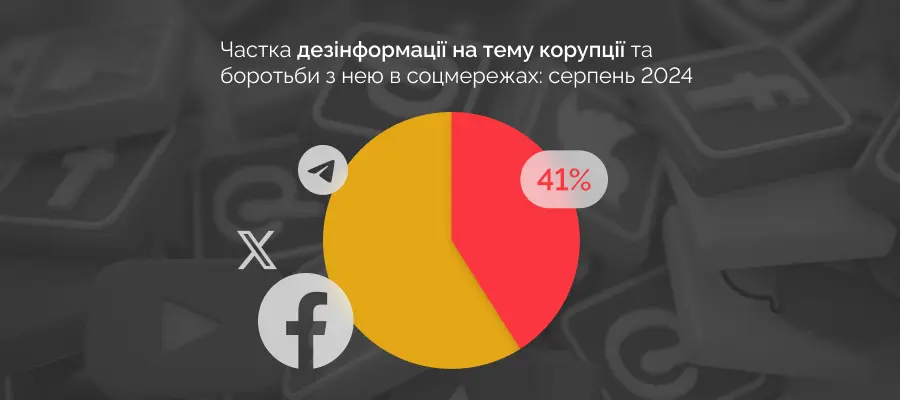
From August 5 to September 1, Osavul analyzed 109 K messages in the Ukrainian segment of social networks, including Telegram, Facebook, and X/Twitter. These messages received 144.5 million views, of which 58.74 million were views of content distributed by malicious accounts that have compromised themselves by regularly participating in coordinated influence operations. That is, the share of corruption-related disinformation spread among the Ukrainian social media audience in August was almost 41%. At the same time, analysts identified 608 sources with proven links to the Russian state.
Disinformation narratives about corruption and the fight against it are often based on authentic events that gain public resonance. For example, the detention of the Deputy Minister of Energy and heads of several Territorial Centers of Recruitment and Social Support in Kyiv region, the suspicion of the head of the Antimonopoly Committee, and the fleeing of MP Dmytruk abroad provided a favorable basis for propaganda messages last month. Such situations allow propagandists to reinforce negative narratives about the total corruption of the state and the futility of fighting corruption in Ukraine by referring to true incidents.
During this period, narratives were actively promoted that the allegedly artificially created collapse in the energy sector and Ukraine's military operations in Russia were only a distraction from the problems of corruption and mobilization. One of the dominant narratives was that the state was unable to win the war because of high corruption, and therefore the country needed to stop the military operations and focus on fighting corruption; it was corruption that needed to be fought, not Russia; some regions were looking forward to the Russians because Ukrainian officials were mired in corruption; the Russian language was better than war and corruption, etc.
At the same time, the initiators of disinformation campaigns are actively using all significant events in the country to link them to the theme of inevitable corruption. Sometimes the propaganda messages look ridiculous but still resonate with the audience. In particular, last month, malicious communications focused on the military operation of the Armed Forces of Ukraine in the Kursk region, the legislative ban on religious organizations affiliated with Russia, overcoming the consequences of the shelling of Okhmatdyt, Independence Day, and even the participation of Ukrainian athletes in the Olympic Games in Paris.
The following messages are among the most extravagant “insights” on these topics. In the context of the Kursk operation, there were reports that the President of Ukraine had launched an offensive on Russian territory to provoke a disproportionate nuclear strike in response and thus avoid responsibility for corruption on an outrageous scale. The messages were disseminated under the name of a professor at the University of Helsinki.
The adoption of the law on the possible ban of the Ukrainian Orthodox Church (Moscow Patriarchate) was accompanied by messages that mainly Orthodox Christians affiliated with Moscow are now subject to mobilization.
The propagandists claimed that the attack on Okhmatdyt was China's revenge for the Ukrainian government's corruption schemes with Motor Sich and that the National Bank's issuance of an updated banknote to mark the 33rd anniversary of Ukraine's independence was the result of a corrupt plot to print more national currency covertly. Finally, Russian and related accounts claimed that Ukraine lost a gold medal in Greco-Roman wrestling at the Olympics due to corruption, as it did not allow an athlete to compete who ended up competing for another country and won.
Such examples prove that propaganda resorts to a variety of interpretations and cause-and-effect relationships, not shying away from openly exotic versions of events, which allows saturating the information space for different target audiences with different levels of media literacy.
Tracking disinformation on corruption, as well as creating and disseminating narratives that disprove disinformation narratives, is one of the measures defined by the Strategy for Communications in the Field of Countering and Preventing Corruption for the period up to 2025 and the State Anti-Corruption Program for 2023-2025. Earlier, the NACP, together with the Center for Strategic Communications and Information Security, presented the results of a study on Russian information threats on corruption in the Ukrainian media space.