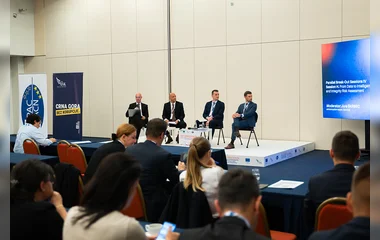

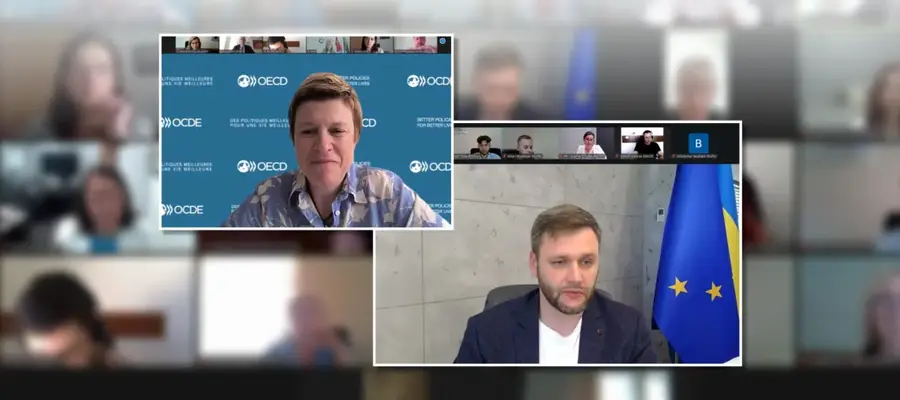
The practical implementation of lobbying legislation, international transparency standards, and mechanisms for ethical interaction between the government, business, and civil society were discussed during the webinar “Building bridges, balancing interests: Transparent lobbying for democratic resilience in Ukraine”, organized by the Organization for Economic Co-operation and Development (OECD) with the support of the National Agency on Corruption Prevention (NACP) and the Research Service of the Verkhovna Rada of Ukraine (RS of the VR of Ukraine).
The event brought together OECD experts, representatives of parliament and the NACP, as well as experts from Canada, France, and Lithuania. Participants discussed international standards for regulating lobbying activities, mechanisms for ensuring transparency and integrity, as well as the practical experience of countries that already have effective lobbying regulation systems, particularly regarding the maintenance of lobbyist registries, government oversight, corporate accountability, and responses to violations of the law. Special attention was given to the OECD Recommendations on Transparency and Integrity in Lobbying and Influence - the first international standard defining the principles of open and responsible lobbying.
“For Ukraine, the issue of lobbying holds particular importance today. We are introducing a new legal framework aimed at establishing a modern system of interaction between the government, business, and civil society, based on openness, transparency, and trust. Therefore, the opportunity to learn from the experiences of Canada, France, Lithuania, and OECD experts is extremely valuable. This helps not only to adopt best practices but also to avoid the mistakes that other countries have already made,” said Viktor Pavlushchyk, Head of the NACP.
He emphasized that transparent lobbying is not only an important element of democratic governance but also a key component of Ukraine’s European integration. That is why the NACP continues to improve legislation in this area in accordance with the Roadmap on the Rule of Law and the Roadmap on the Functioning of Democratic Institutions, prepared as part of the negotiation process regarding Ukraine’s accession to the European Union.
The webinar took place as part of the OECD’s four-year Country Program for Ukraine, launched in 2023. As part of the program, the OECD provides expert support to the NACP in building a transparent lobbying system, specifically in developing a methodology to assess compliance with Ukraine’s Law “On Lobbying” and in conducting specialised training on ethics, integrity, and good governance. The discussion was joined by János Bertók, Head of the OECD’s Public Governance Directorate; Denys Maslov, Chair of the VR of Ukraine Committee on Legal Policy; and Lesia Vaolevska, Head of the RS of the VR of Ukraine. The meeting was moderated by Elena Koncevičiūtė, Head of Country Projects, Anti-Corruption, Integrity and Open Government Division of the OECD Public Governance Directorate.
It should be noted that although the institution of lobbying in Ukraine is still in its early stages, our country is already among the world leaders in terms of its regulatory framework and practical implementation, as confirmed by the results of the OECD Anti-Corruption and Integrity Outlook 2026, which covers 62 countries and is based on the OECD Public Integrity Indicators. It covers topics such as anti-corruption strategies, conflicts of interest, political finance, transparency of public information, and lobbying regulations. For each country, established regulatory frameworks are compared with their practical implementation.
Based on the OECD’s analysis, Ukraine meets 80% of the criteria regarding the regulatory framework of lobbying and 89% of the criteria regarding its practical implementation. By comparison, the average among OECD member countries is 43% and 38%, respectively. Based on these indicators, Ukraine is on par with countries such as Canada and France.
The OECD notes that Ukrainian legislation already contains all the key elements of a modern lobbying regulatory system: a clear definition of lobbying activities, mandatory registration of lobbying entities, requirements for disclosing information about lobbyists, their clients, the subject of lobbying, and sources of funding, the establishment of ethical standards, sanctions for violations of the law, and restrictions on former public officials.
The NACP plays a key role in the functioning of this system as the holder and administrator of the Transparency Register, as well as the body responsible for state oversight of compliance with lobbying legislation. The public part of the Register contains information about lobbying entities, their areas of activity, sources of funding, and the individuals on whose behalf lobbying is conducted. It is precisely this transparency regarding the beneficiaries of lobbying influence that the OECD has identified as one of the strengths of the Ukrainian model. The Transparency Register has been recognised as one of the most functional and user-friendly among the countries covered by the review.
We would also like to remind you that the reporting campaign on lobbying activities for the first half of 2026 is underway from July 1 through July 31, 2026. Reporting is one of the key tools for ensuring transparency and accountability within the new lobbying framework.