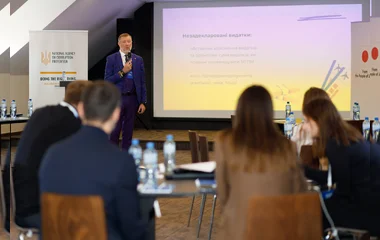
Serhii Hupiak, Deputy Head of the National Agency on Corruption Prevention (NACP), presented Ukraine's experience in corruption prevention during the 43rd Cambridge International Symposium on Economic Crime.
During the panel discussion, Serhii Hupiak emphasised that under conditions of war, a preventive approach to anti-corruption policy takes on special significance. This primarily involves systematically identifying and minimising corruption risks in sectors where significant financial resources are concentrated, critical state decisions are made, and action must be taken as quickly as possible.
The Deputy Head of the NACP stressed that anti-corruption policy must be based on five interconnected components: education and awareness-raising, high-quality legislation, digitalisation, financial and other controls, and the inevitability of accountability.
All these elements are integrated into the Anti-Corruption Strategy for 2026–2030, which has currently been submitted to the Verkhovna Rada of Ukraine for consideration. It contains a conceptual approach that combines two key, interconnected vectors for the development of state anti-corruption policy: increasing the efficiency of the entire anti-corruption system and minimizing corruption risks in the most affected and strategically important sectors. The Strategy defines 16 priority sectors where corruption risks have the greatest impact on the state and society. These notably include: the judiciary and the status of judges; the prosecution service, law enforcement, and crime prevention; the legal profession and legal aid; defense; construction; reconstruction; energy; public procurement; state regulation and economic control; taxation; customs affairs; subsoil use; land management; the agricultural sector; healthcare; and education and science.
The approach embedded in the Strategy reflects Ukraine's transition to a preventive anti-corruption policy model—moving from reacting to already committed violations toward the systematic management of corruption risks.
Analysing corruption risks in such strategically important sectors for the state is one of the key focus areas of the NACP's work, which has already conducted a series of relevant studies and provided recommendations to eliminate potential risks within them.
For instance, in the security and defence sector, research was conducted into the procurement of weapons, unmanned systems, and electronic warfare equipment, centralised rear-area procurement for the needs of the Armed Forces of Ukraine, the operation of military medical commissions, and housing provision for military personnel. These studies highlighted systemic risk factors such as constant legislative changes, the lack of a unified approach to procurement (especially regarding innovative technologies), imperfect pricing mechanisms, tight decision-making deadlines, and the specific processes involved in defining needs and selection criteria for procurement items.
"Ukraine has already done a great deal to reduce risks in the defense sector, in part through the work of the NACP, but a significant amount of work remains. Our task is to identify systemic causes that create opportunities for violations and to amend the relevant rules. For Ukraine, this issue carries not only an anti-corruption dimension but also a security one: the efficiency of public resource utilisation directly impacts the country's defence capabilities," noted Serhii Hupiak.
In the public procurement sector, according to NACP research, risks arise from allowing procurement under the condition of a single bid submission, bids submitted at prices higher than the expected value without proper pricing justification, the creation of artificial barriers for individual participants, and the conclusion of direct contracts. Some of these mechanisms were a response to wartime challenges that required rapid operational decisions in short timeframes. However, according to Serhii Hupiak, these realities necessitate strengthening other safeguards against potential corruption abuses.
Special attention during the panel was devoted to Ukraine's future reconstruction. Serhii Hupiak emphasised that transparency and accountability must be embedded not after project completion, but as early as the planning stage.
Among the systemic risks in the reconstruction sector, the NACP identifies the lack of clear criteria for project selection and prioritisation, gaps in the legislative regulation of reconstruction processes, insufficient oversight of design documentation quality, flaws in construction supervision services, procurements conducted outside the electronic system, the conclusion of direct contracts, inadequate control over the material terms of construction contracts, and the absence of fully integrated digital monitoring over payments and performance of work. Digital tools play a crucial role in this process. Specifically, the DREAM system is designed to ensure transparency and oversight at various stages of reconstruction projects. At the same time, digitalisation must be accompanied by effective state and public oversight.
Serhii Hupiak also specifically presented the NACP's experience in conducting anti-corruption expertise.
In 2026, the NACP monitored 2,112 draft legal acts, conducted anti-corruption expertise on 116 of them, identified 142 corruption-generating factors, and provided 369 recommendations. Ninety-nine per cent of the Agency's recommendations were taken into account.
Anti-corruption expertise, like strategic analysis, enables the identification of potential corruption risks before the relevant norms enter into force and allows for their elimination at the policy-shaping stage.
For over 40 years, the Cambridge Symposium has served as an international platform for discussing the prevention and countering of economic crime, corruption, financial violations, and illicit asset flows. Each year, it brings together more than 2,000 participants from over 100 countries, including representatives of governmental and judicial authorities, law enforcement and regulatory bodies, international organisations, business, professional associations, and academia. This year's event was dedicated to asset recovery and the rule of law under the theme "Asset Recovery and the Rule of Law." The Ukrainian panel has already become a traditional part of the symposium. Its objective is to present Ukraine's experience in combating corruption and economic crime to an international audience, as well as to discuss the challenges facing Ukraine during the war and the future reconstruction process. The Ukrainian panel was organised by the "Future of Ukraine" program at the Centre of Geopolitics, University of Cambridge.