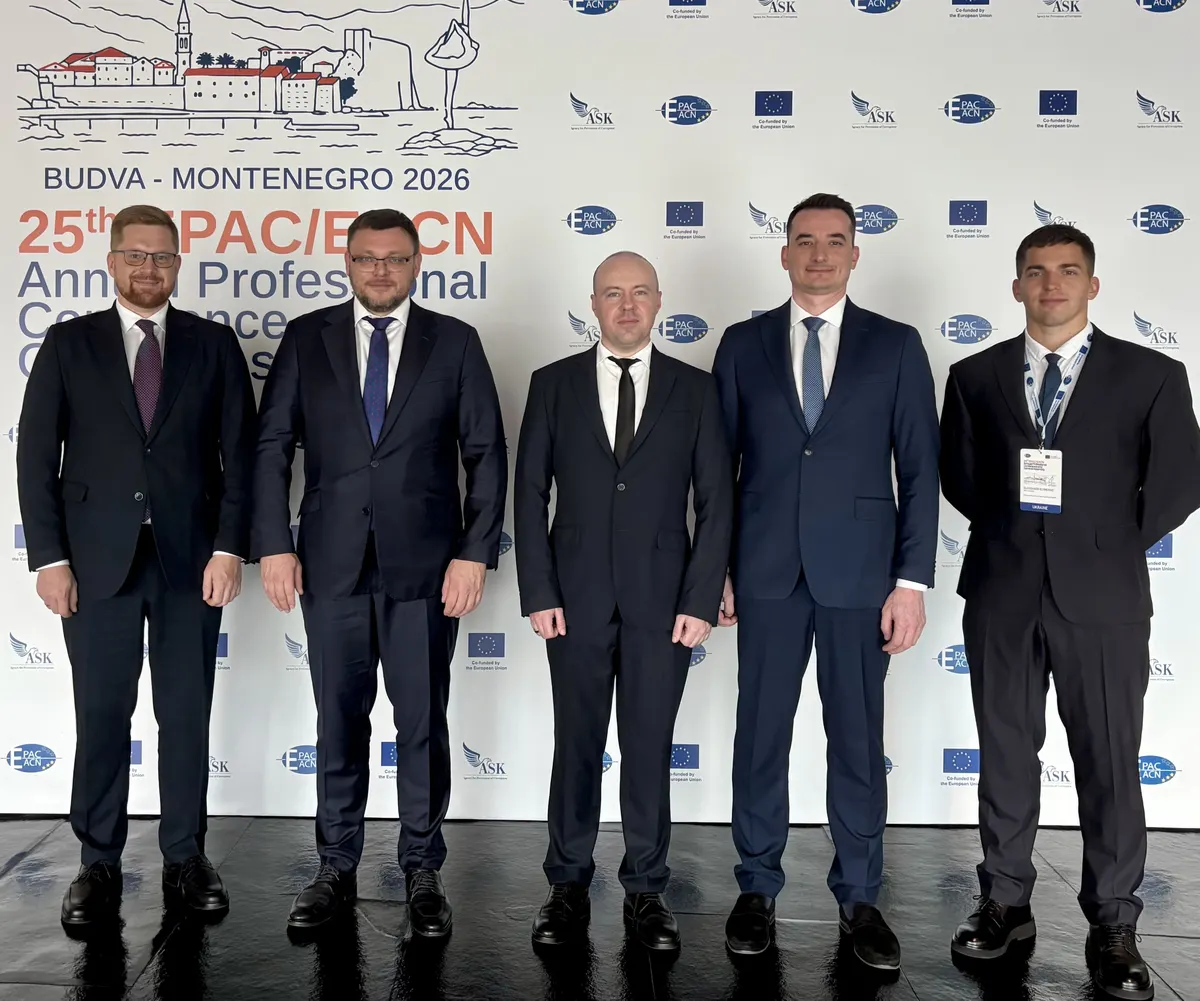
A delegation of the National Agency on Corruption Prevention (NACP) took part in the 25th annual professional conference and General Assembly of the European Partners Against Corruption (EPAC/EACN), held in Budva (Montenegro).
During the event, Agency representatives presented Ukraine's experience to European colleagues in shaping a comprehensive approach to minimising corruption risks in the defence, reconstruction, and education sectors under wartime conditions, as well as the use of digital tools.
NACP Deputy Head Serhii Hupiak spoke about the operation of the anti-corruption infrastructure and presented the Agency's work priorities aimed at minimising risks during the war.
"The anti-corruption component is currently being integrated into all negotiation chapters regarding Ukraine's accession to the EU. In addition, the NACP has been designated as the National Coordinator of Ukraine-NATO Cooperation on Building Integrity, under which the Building Integrity in the Defense Sector Community (BI Defence Community) was created in 2026," noted Serhii Hupiak.
According to him, the NACP pays significant attention to the anti-corruption expertise of normative legal acts. During the first seven months of 2026, the NACP monitored over two thousand draft laws. The level of recommendation adoption by lawmakers regarding the elimination of corruption-generating factors reached 99%. A systematic analysis of procurement risks for the Armed Forces of Ukraine (in particular, UAVs and electronic warfare equipment) and during reconstruction is also being conducted.
Traditionally, as part of the annual professional conference, a competition for the EPAC/EACN Award for the best initiative and the most innovative idea promoting transparency was held. NACP Deputy Head Serhii Hupiak presented Ukraine's experience in implementing the Integrity Development Strategy in Education for 2026–2030. The document provides for 119 specific, measurable measures with clear performance indicators.
More than 600,000 pupils, students, and teachers have joined the NACP’s educational projects "Transparent School," "Transparent Vocational Education," and "Transparent Universities." Anti-corruption courses have been introduced in 108 higher education institutions. Twenty-three Integrity Hubs have been established in the regions. Additionally, the Study.NAZK educational platform is operational, with 320,000 registered users. The main goal of the Strategy for the next 5 years is to reduce the level of citizens' involvement in corrupt practices to below 10%. Following the vote, Ukraine's project secured third place.
Mykhailo Mykhailovskyi, Head of the NACP Digital Transformation and Innovative Development Department, presented the NACP's IT tools and discussed scaling analytics for assessing corruption and integrity risks.
To date, Ukraine's Register of Declarations is the world's largest open database of officials' assets, containing approximately 10 million declarations.
During his speech, Mykhailo Mykhailovskyi shared key results of working with data, the risk-based approach, full verifications of declarations, lifestyle monitoring, and checking political party reports.
"The NACP system interacts with 21 state registers. Using the 'Data for Declaration' service, officials retrieve data from registers and can partially populate a draft declaration. Each year, the logical and arithmetical control (LAC) module performs over 67 million automated checks, assigning a risk index to every declaration. Thanks to this risk-based approach, the NACP does not dissipate resources on continuous manual control, but focuses the expert attention of analysts specifically on anomalies and potentially unlawful actions. This delivers maximum return on verifications: it optimises working time and state resources, significantly increases the effectiveness of detecting illicit enrichment and concealed assets, and minimises the subjective human factor," noted Mykhailo Mykhailovskyi.

According to him, the NACP also continues to develop its analytical ecosystem under conditions of limited resources. To strengthen public oversight, the NACP conducted practical training sessions, including on the use of NACP open data, for 120 regional investigative journalists across eight cities in Ukraine, which improved the quality of materials submitted to the NACP.
"When we cannot instantly scale infrastructure due to a lack of resources, we can scale the ecosystem. By combining automated state analytics with the vigilance of civil society and investigative journalists, we turn data into legal consequences," summarised the NACP department head.
The 25th annual professional conference and General Assembly of European Partners Against Corruption (EPAC) and the European contact point network against corruption (EACN) took place in Budva. Following the conference, participants adopted the Budva Declaration, which reaffirms the European network's commitment to safeguarding public integrity and the EU's financial interests through practical cooperation.
Over 180 participants attended the event in Budva, representing more than 85 organisations from over 30 European countries. This year, the conference was organised in cooperation with the Agency for Prevention of Corruption of Montenegro and co-funded by the EU.
As a reminder, the NACP officially became a member of the European Partners Against Corruption (EPAC/EACN) network in 2024. In 2025, the Agency presented its experience in ensuring procurement transparency during Ukraine's reconstruction and implementing its anti-corruption communications strategy (2023–2025).