
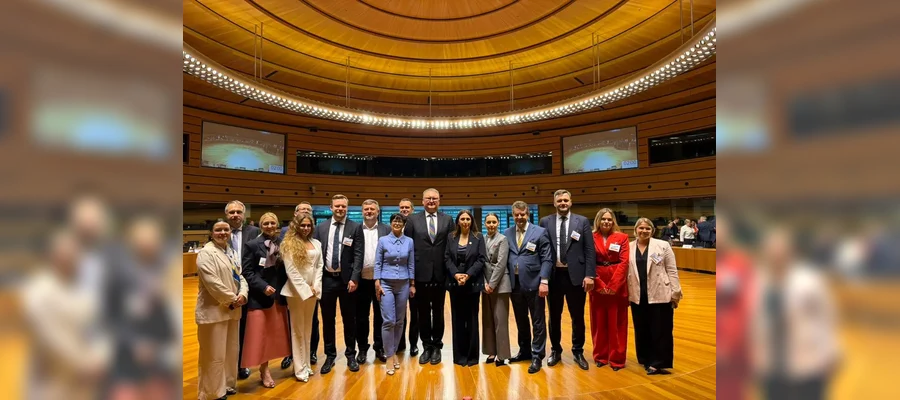
On June 15, 2026, in Luxembourg, during the second Ukraine-EU Intergovernmental Conference, the negotiation process for Cluster 1, "Fundamentals of the EU Accession Process" (Fundamentals), was officially opened. Ukraine also officially accepted the benchmarks (conditions for progress) set by the European Union to advance the negotiation process.
The Ukrainian delegation included representatives of the Verkhovna Rada of Ukraine, the Office of the President of Ukraine, the Cabinet of Ministers of Ukraine, ministries, and other state bodies. The National Agency on Corruption Prevention (NACP) was represented at the conference by the Head of the Agency, Viktor Pavlushchyk.
Cluster 1 is decisive for the entire negotiation process regarding accession to the European Union. According to the EU enlargement methodology, it opens first and remains open until the conclusion of membership negotiations. The cluster covers issues of the rule of law, anti-corruption and countering corruption, the functioning of democratic institutions, public administration reform, the protection of fundamental rights, financial control, justice and security, the development of a market economy and ensuring macro-financial stability, public procurement, and statistics. It is progress in these areas that will determine the pace of further negotiations on Ukraine's accession to the EU.
To open negotiations under Cluster 1, Ukraine fulfilled the necessary preparatory conditions, in particular, developed and began the implementation of Roadmaps — in the field of the rule of law (of which Section II "Fight against Corruption" and "Anti-Corruption Mainstreaming" are components), on public administration reform, and the functioning of democratic institutions, as well as the Action Plan for the protection of the rights of persons belonging to national minorities (communities).
During the conference, Ukraine confirmed that it accepts the acquis of the European Union (EU law) in its current version and in the form in which it will develop until the moment of our state's accession to the EU. At the same time, Ukraine confirmed the absence of requests for special conditions, exemptions, or transitional periods within Cluster 1. The Ukrainian side also confirmed its commitment to the further implementation of reforms in the key areas of the cluster.
An important component of the "Fundamentals" Cluster remains the area of formation and implementation of anti-corruption policy. The adoption and proper implementation of the Anti-Corruption Strategy for 2026–2030 and the State Anti-Corruption Programme for its execution are of crucial importance for ensuring sustainable and resilient improvement of the situation in this area. Other priorities for the near future include the need to introduce comprehensive amendments to the legislation to ensure swift and high-quality justice (in particular, preventing the abuse of procedural rights), strengthening the independence and institutional capacity of the National Agency on Corruption Prevention, the National Anti-Corruption Bureau of Ukraine, the Specialized Anti-Corruption Prosecutor's Office, and the High Anti-Corruption Court, as well as the systemic improvement of the Code of Ukraine on Administrative Offences to ensure the inevitability of administrative liability for top officials for committing corruption-related offences.
Within the framework of the negotiation process, the European Union will assess not only the adoption of the necessary decisions but also the effectiveness of their practical implementation. That is why Ukraine's further movement towards membership will depend on the sustainability of reforms and the achievement of concrete results in key areas of state policy.
The opening of Cluster 1 is an important political signal of support for Ukraine's European course from all 27 EU member states, which unanimously adopted the relevant decision, and a confirmation of Ukraine's progress in meeting the prerequisites for further advancement on the path to membership in the European Union.
For Reference
Negotiations on Ukraine's accession to the European Union are conducted across 35 negotiating chapters, which cover the main areas of EU law and policies. According to the updated EU enlargement methodology, 33 chapters are grouped into six negotiating clusters. Chapters 34, "Institutions," and 35, "Other Issues", are considered separately.